
Why Your Commercial Exhaust Fan Is a Critical Safety System
A commercial kitchen exhaust fan is one of the hardest-working pieces of equipment in any food service operation. It runs continuously during service hours, handling enormous volumes of grease-laden, superheated air — day after day, year after year. When it works well, nobody notices. When it fails, the consequences can be immediate and severe: smoke fills the kitchen, temperatures spike, health inspectors cite violations, and — in worst-case scenarios — grease fires find the fuel they need to spread.
That’s exactly the situation the team at Operation Comfort Control, LLC encountered at this commercial kitchen location. A long-neglected rooftop exhaust fan had deteriorated to the point of structural failure. Our crew documented every stage of the changeout — from the damaged unit we found on arrival to the fully operational CaptiveAire installation we left behind.
This post walks through the complete project: the warning signs that were present, the damage we found, the equipment we specified, how the installation was carried out, and what a properly functioning exhaust system means for your kitchen’s safety, compliance, and long-term operating costs.
Whether you manage a single restaurant or a portfolio of food service locations, this real-world case study shows you exactly what a professional exhaust fan changeout looks like — and why getting it right the first time matters. Explore our full range of commercial kitchen services to learn how we protect your operation.
The Problem: A Rooftop Exhaust Fan Well Past Its Service Life
What We Found on Arrival
Our technicians arrived to find a rooftop exhaust fan in critical, beyond-repair condition. The visible damage was extensive, and it was immediately clear that this unit had been operating in a compromised state for some time — meaning the kitchen had been at elevated fire and ventilation risk without anyone realizing the full extent of the deterioration.
Here is what our initial inspection documented:
- Cracked and fully separated fan housing — structural breaks running along the entire rim
- Heavy black grease deposits coating the unit, the roof curb, and surrounding roof surface
- Deteriorated and failed seals allowing grease-saturated exhaust air to bypass the fan housing
- Severe corrosion on metal surfaces throughout — signs of long-term moisture and grease exposure
- Compromised fan blades from years of grease accumulation and mechanical wear
- Electrical connections showing wear and inadequate weatherproofing for rooftop installation
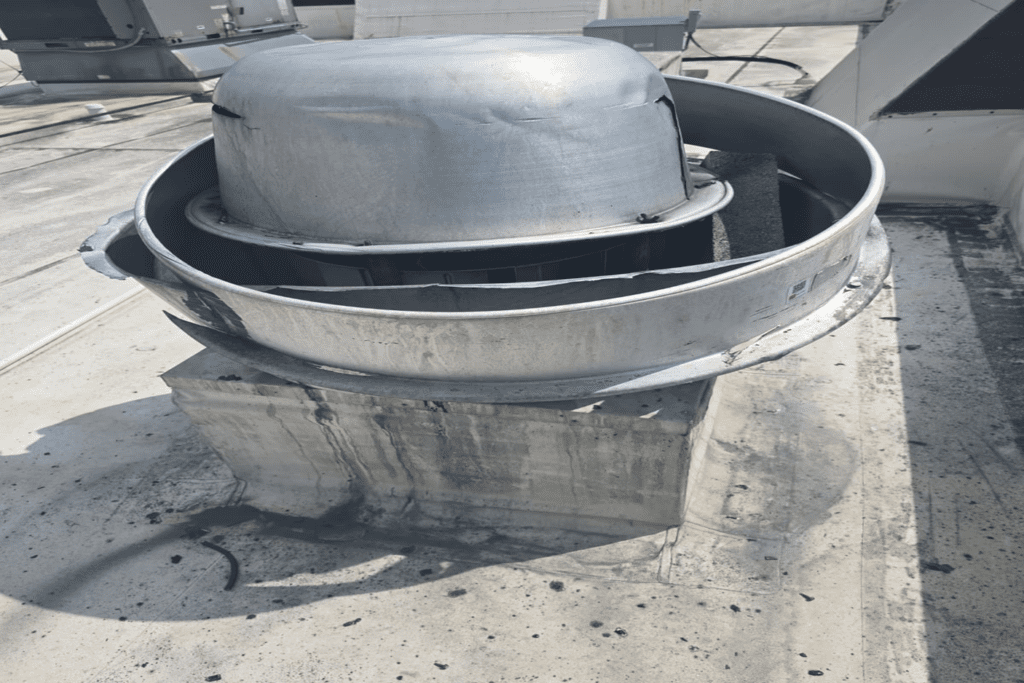
A unit in this condition is not just inefficient — it is actively dangerous. The National Fire Protection Association’s NFPA 96 standard, which governs commercial kitchen ventilation, requires that exhaust fans maintain structural integrity and proper airflow. A cracked housing that allows grease-laden air to escape around the fan base is a direct fire code violation and creates a potential ignition source on the roof.
Close-Up: The Broken Fan Housing
The close-up inspection revealed the full extent of the housing damage. Multiple fracture lines ran through the critical sealing surfaces of the fan housing — the areas that are supposed to contain all exhaust airflow within the designed path up through the fan and out into the atmosphere.
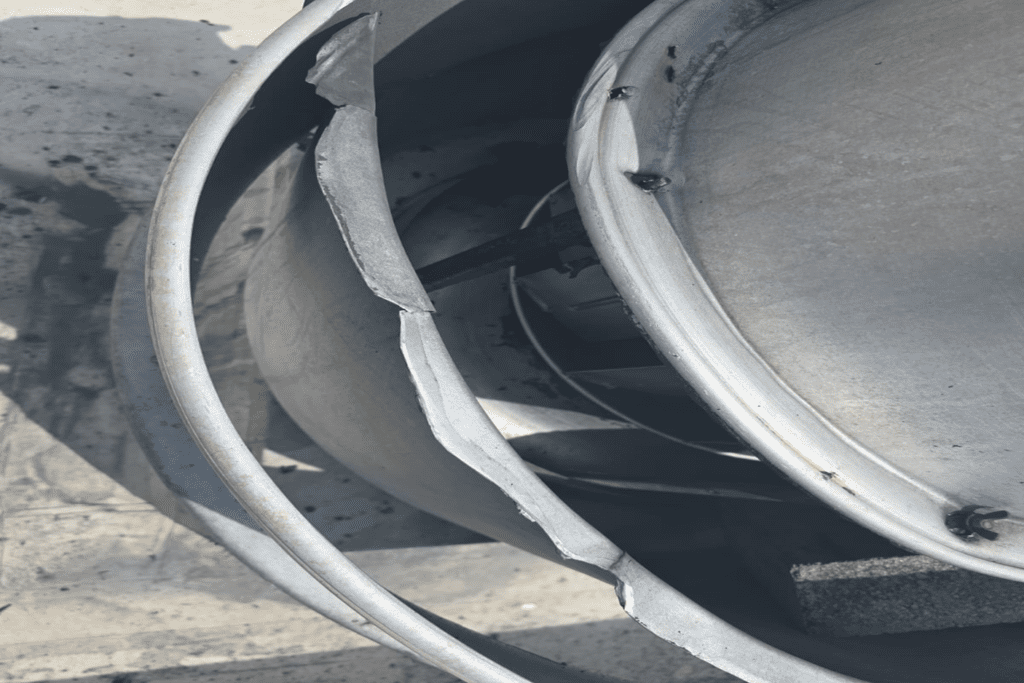
These breaks are not repairable. Unlike a worn belt, a failed capacitor, or a dirty filter — all of which can be serviced — a structurally compromised housing must be replaced entirely. Attempting to patch or seal cracks in a grease exhaust fan housing is not a code-compliant solution and does not restore the unit to safe operation. Replacement was the only correct path forward.
The Old Unit Removed — Documentation of Condition
After safely de-energizing the unit and disconnecting all electrical connections, our crew unbolted the old fan from the roof curb and removed it. Once down from the curb, the full scope of deterioration was even clearer. Grease had penetrated every joint and seam. The internal components showed years of heat cycling and mechanical wear. This unit had given everything it had — it was simply done.
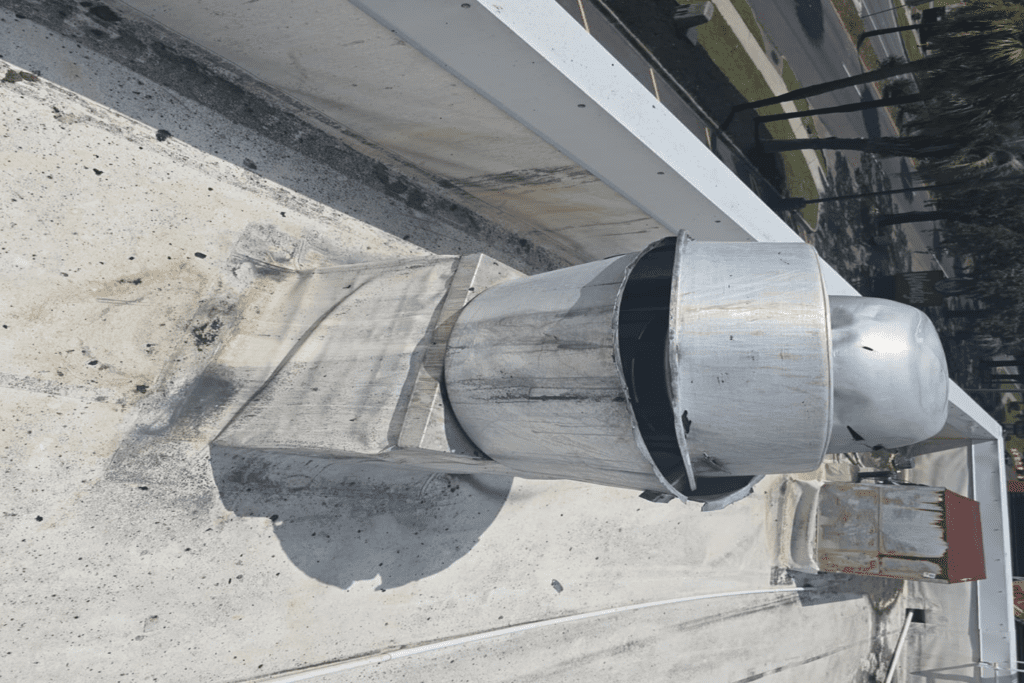
At Operation Comfort Control, LLC, we photograph every removal and document the before-condition thoroughly. This documentation protects our clients during insurance claims, warranty discussions, and health inspection follow-ups — and ensures we have a complete record if any questions arise about what was found and what was done.
The Solution: Specifying and Installing the Right Replacement
Why We Chose the CaptiveAire DU85HFA
For this replacement, our team specified a CaptiveAire Model DU85HFA upblast exhaust fan. CaptiveAire is the largest manufacturer of commercial kitchen ventilation equipment in North America, and their upblast fan series is the industry benchmark for restaurant exhaust applications. The DU85HFA was selected based on the ductwork size, required airflow (CFM), static pressure requirements, and the single-phase electrical service available at this location.
Choosing the correct replacement unit isn’t simply a matter of finding something that physically fits on the curb. Airflow calculations must account for the hood size, cooking equipment type, exhaust duct length and diameter, and local code requirements. Installing an undersized unit — even a brand-new one — will leave you with the same ventilation problems you started with. Our team performs proper sizing calculations on every replacement job.
Equipment Specifications
Here are the full specifications from the CaptiveAire DU85HFA label, documented at installation:
- Model: DU85HFA — Captive Aire up blast exhaust fan
- Motor: 0.750 HP, 115 VAC, 1 Phase, 60 Hz
- Max Rated RPM: 1900
- Airflow: 2006 SCFM at rated conditions
- External Static Pressure: 0.750 in. wc
- MCA: 11.2 Amps | MOCP: 20 Amps | Minimum Wire: 14 AWG
- Maximum Operating Temperature: 360°F — rated for grease exhaust
- AMCA Certified — independently verified airflow and sound ratings
- UL Listed — General Ventilation and Grease Application
- QC Passed — factory quality control verified before shipment
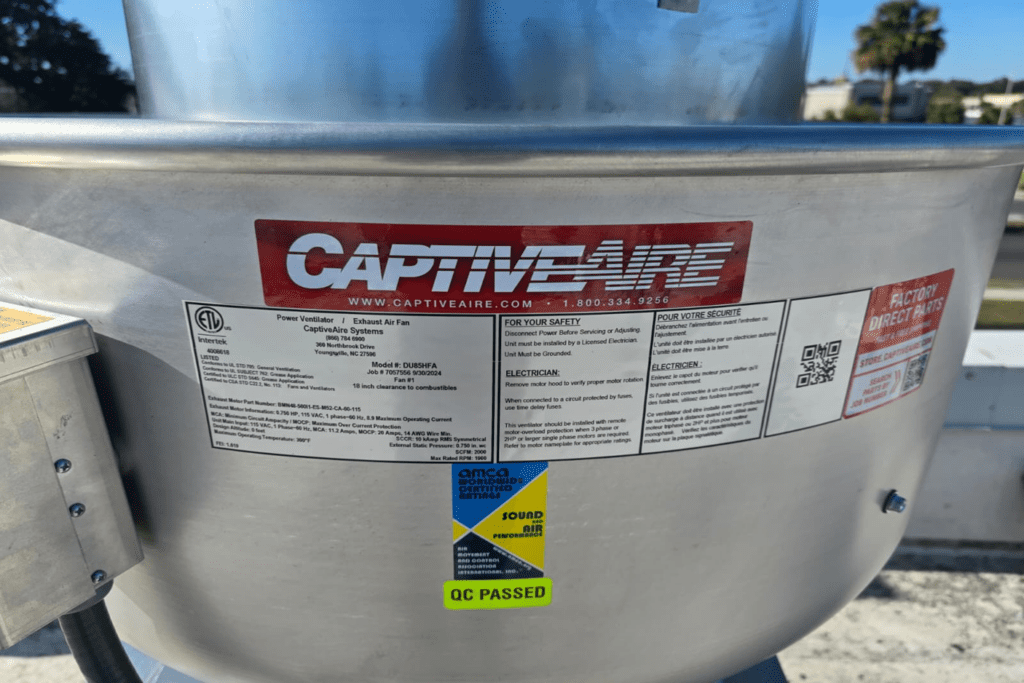
The AMCA certification is particularly significant. It means that the airflow and sound ratings printed on this fan have been independently tested and verified — not just stated by the manufacturer. When you invest in AMCA-certified equipment, you know the unit will actually perform at spec in the field. The 360°F maximum operating temperature rating confirms this unit is properly designed for grease exhaust service, where temperatures at the fan inlet can spike dramatically during high-volume cooking.
The Installation Process: How We Did It Right
Roof Curb Preparation and Adapter Installation
A proper exhaust fan installation begins at the roof curb — the structural base that connects the rooftop fan to the ductwork below. Before setting the new unit, our technicians cleaned the curb surface thoroughly, inspected for any structural damage or deterioration, and verified that the curb dimensions were compatible with the new fan’s base.
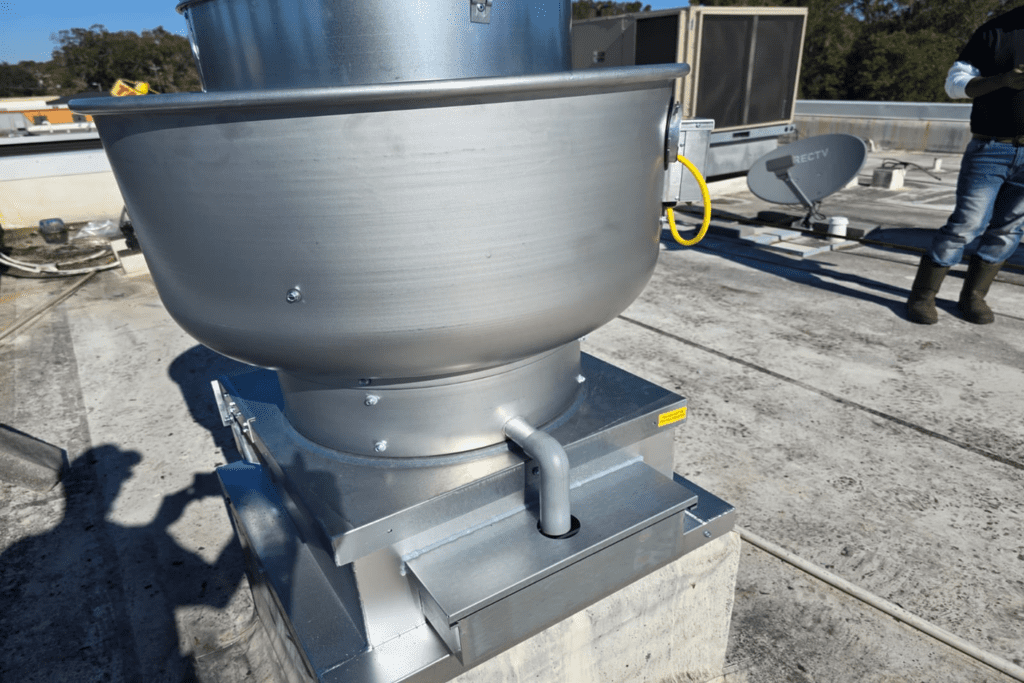
We installed a new galvanized steel curb adapter to provide a clean, flat, properly-dimensioned mounting surface for the new fan. The grease drain line — the gray elbow pipe visible in the side-view photo — was also carefully routed during this stage. This drain is critical: it channels any condensed grease from the fan housing down through the curb and into the ductwork drain path, preventing grease from pooling on the roof surface. Many contractors overlook this detail; our crew treats it as a required installation step on every job.
Setting, Aligning, and Securing the Fan
With the curb prepared, the new CaptiveAire DU85HFA was carefully positioned and set. Our technicians aligned the unit precisely with the ductwork centerline below, verified it was level, and secured it with the appropriate stainless-steel fasteners. The base-to-curb joint was inspected to confirm full contact around the entire perimeter — any gap here becomes a grease leak point and a fire hazard.
Electrical Connection and Grounding
All electrical work was performed in compliance with NEC (National Electrical Code) requirements. The new unit was wired to a properly-rated 20-amp circuit with appropriate time-delay fuses as specified on the CaptiveAire label. The connection box was weatherproofed to protect against Florida’s outdoor elements — moisture intrusion into electrical connections on rooftop equipment is a common cause of premature failure that proper weatherproofing prevents.
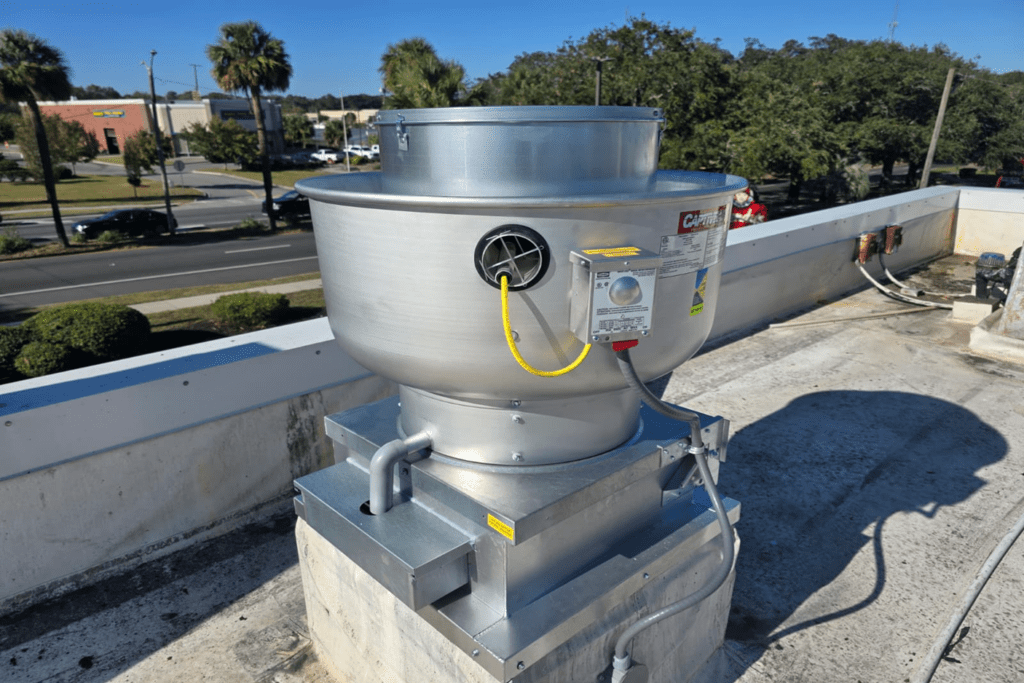
The yellow ground wire visible in the photo is more than just code compliance — on rooftop equipment exposed to lightning risk, proper grounding is a real-world safety measure. Our team verifies all grounding continuity before energizing any new equipment installation.
Operational Test and Final Verification
After completing all mechanical and electrical connections, we performed a comprehensive operational test before signing off on the installation:
- Verified correct motor rotation direction through the motor hood access port
- Confirmed airflow at design specification — no restrictions or blockages
- Checked for unusual vibration or noise — none detected
- Verified grease drain path was clear and properly sloped to drain
- Confirmed all fasteners were torqued to manufacturer specification
- Measured electrical draw — within rated amperage
- Inspected base seal for complete contact around full perimeter
The Result: A Professional, Code-Compliant Installation
The completed installation is a stark contrast to what we found on arrival. Where there was a cracked, grease-covered, structurally failed unit, there is now a clean, properly sealed, code-compliant CaptiveAire upblast fan — delivering the full 2006 SCFM of grease exhaust airflow the kitchen requires.
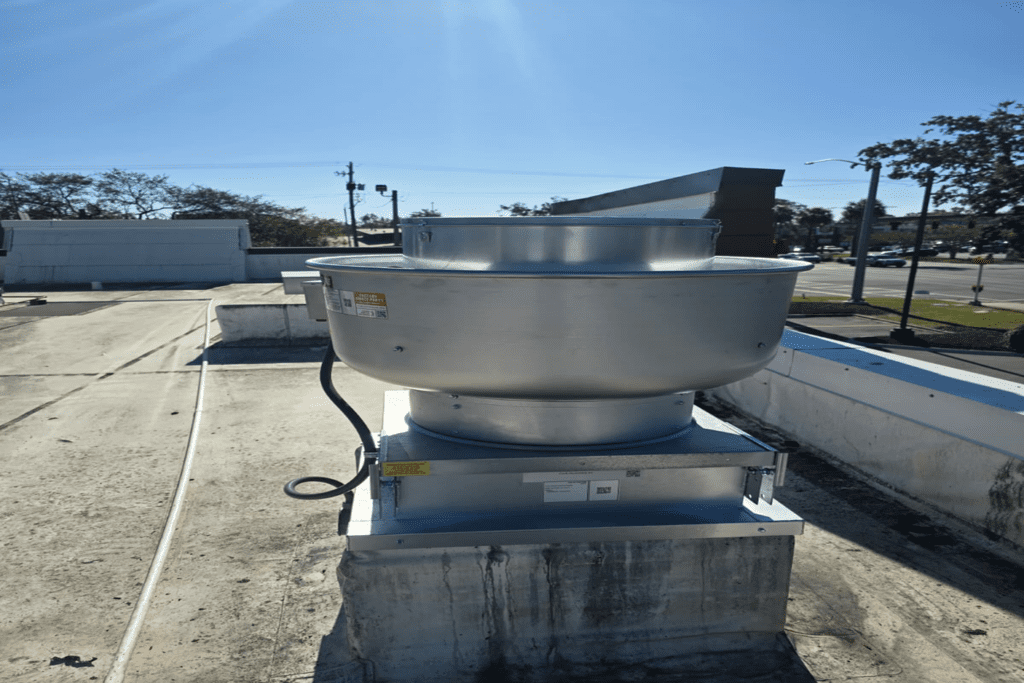
The new unit sits squarely on the roof curb with all hardware properly secured, electrical connections neatly routed and weatherproofed, and the grease drain correctly positioned. The stainless steel construction will resist corrosion for years to come — especially important in Florida’s combination of heat, humidity, and coastal salt air.
For more completed project photos like this one, visit our project gallery. Every photo there represents a real job, a real client, and a real solution delivered by the Operation Comfort Control, LLC team.
When Should You Replace Your Commercial Rooftop Exhaust Fan?
Clear Signs That Replacement Is Required
Knowing when to repair and when to replace is one of the most valuable calls an experienced service technician makes. Here are the conditions that indicate full replacement is necessary:
- Cracked or broken housing — structural damage cannot be safely or code-compliantly repaired
- Burned-out or seized motor — especially if it has overheated, and particularly in older units
- Severely corroded housing or base — when corrosion has compromised structural integrity
- Fan blade damage — broken, severely bent, or corroded blades affect balance and airflow
- Unit age beyond 15-20 years — especially with no maintenance history
- Persistent grease leaking around the base — indicating seal failure that cannot be remediated
- Failed inspection citation requiring replacement — health or fire marshal order
- Repeated breakdowns in short succession — sign the unit is at end of life
Repair vs. Replace: The Honest Calculation
Some exhaust fan issues are absolutely worth repairing: a failed run capacitor, a worn drive belt, a dirty filter, or a failed thermostat can all be addressed cost-effectively and return the unit to full performance. But when the housing is cracked, the motor has failed in an older unit, or the corrosion has reached structural components, the honest calculation usually points to replacement.
A new unit comes with manufacturer warranty, AMCA-certified performance ratings, and current UL listings — none of which a repaired old unit can offer. Our team at Operation Comfort Control, LLC will always give you an honest assessment. Learn more about our commercial cooking equipment preventive maintenance program, which helps you catch these issues before they become emergency replacements.
Why Proper Commercial Kitchen Ventilation Is Non-Negotiable
Fire Safety and NFPA 96 Compliance
NFPA 96 — the Standard for Ventilation Control and Fire Protection of Commercial Cooking Operations — is the primary code governing commercial kitchen exhaust systems. It establishes requirements for exhaust fan performance, ductwork, hood design, and maintenance intervals. A failed or damaged exhaust fan puts you out of compliance with NFPA 96, and in the event of a fire, that non-compliance can affect your insurance coverage and legal liability.
Health Code and Inspection Compliance
Commercial kitchen health inspections routinely include a check of ventilation system operation. An inoperable or visibly damaged exhaust fan can result in point deductions, violations, mandatory corrective action timelines, or in serious cases, temporary closure orders. Staying ahead of equipment failures with proactive maintenance and timely replacement keeps your inspection scores strong and your operation running.
Staff Comfort, Productivity, and Retention
A kitchen without adequate ventilation is hot, smoky, and physically exhausting to work in. Elevated temperatures and poor air quality increase error rates, slow service, and are a leading contributor to high kitchen staff turnover. Proper ventilation is not just equipment maintenance — it is an investment in your team’s working conditions and your operation’s reliability.
Protecting Your Full Equipment Investment
When exhaust systems fail, the heat and grease that should be expelled stay in the kitchen — settling on equipment surfaces, clogging refrigeration condenser coils, accelerating wear on cooking equipment, and shortening the service life of everything in the space. A working exhaust fan protects your entire kitchen equipment investment. This is why Operation Comfort Control, LLC offers comprehensive preventive maintenance for your full equipment portfolio — from walk-in cooler preventive maintenance to ice machine preventive maintenance and shake and frozen beverage equipment maintenance.
About Operation Comfort Control, LLC
Operation Comfort Control, LLC is a commercial kitchen and refrigeration equipment specialist serving restaurants, food service facilities, and commercial properties. We are licensed, experienced, and equipped to handle everything from emergency exhaust fan replacements to long-term preventive maintenance programs that keep your entire kitchen operating at peak efficiency.
We work exclusively with industry-leading equipment — like CaptiveAire for exhaust and ventilation applications — and every installation is documented, tested, and backed by our commitment to code compliance and professional workmanship. Our technicians are trained on current NFPA 96, UL, and NEC requirements so every job we complete meets the standards that matter most to your operation.
Learn more about our team and values on our About page, browse our complete services list, or view our walk-in cooler installation capabilities for new construction and replacement projects.
Related Reading
If this post was helpful, you may also want to read: Affordable Appliance Repair in Savannah for Fast, Reliable Fixes — another example of Operation Comfort Control, LLC delivering quality, cost-effective solutions for commercial clients across our service area.
Ready for a Rooftop Exhaust Fan Changeout? Let’s Talk.
If your commercial kitchen exhaust fan is making unusual noises, leaking grease, showing visible damage, or has simply stopped working — do not wait for a health inspection or a fire alarm to force the issue. The team at Operation Comfort Control, LLC is ready to assess your situation and deliver a professional, code-compliant replacement fast.
Here’s what you can expect when you call us:
- Fast response — we understand that kitchen downtime costs real money every hour
- Honest assessment — we tell you what needs replacing and what can wait
- Proper sizing — we calculate the right unit for your specific kitchen, not just the closest physical fit
- Licensed technicians — every installation meets NEC, NFPA 96, and local code requirements
- Industry-leading equipment — CaptiveAire and other top-tier manufacturers
- Full documentation — before, during, and after photos on every project
- Competitive pricing — no surprise fees, clear estimates before work begins
★ Contact Operation Comfort Control, LLC Today ★
