
If your coffee shop, restaurant, or cafe depends on an espresso machine to serve customers, then you already know: even a single hour of downtime can mean hundreds of dollars in lost revenue. A broken control board or a failing water solenoid valve on your commercial espresso machine is not just an inconvenience — it’s a business emergency.
At Operation Comfort Control LLC, we specialize in professional commercial espresso machine maintenance and repair across Savannah, GA and surrounding areas. In this post, we’re going to walk you through a real-world control board and water solenoid replacement we completed on an Estella Caffe espresso machine at a downtown Savannah, GA coffee bar — explaining what went wrong, how we fixed it, and why regular preventive maintenance is the smartest investment any food service business can make.
Whether you run a busy coffee shop, a hotel lobby cafe, or a full-service restaurant, this guide will help you understand the critical role of your espresso machine’s electronic and hydraulic components — and what to do when they fail.
Expert Repair for Estella Caffe Espresso Machines in Savannah, GA
Our technicians were called in to service an Estella Caffe single-group espresso machine that had stopped pulling shots correctly. The customer — a popular downtown Savannah coffee bar — reported inconsistent water flow, error codes on the display panel, and an inability to brew at the correct pressure.
After a full diagnostic inspection, our team identified two root cause failures:
- A faulty main control board (PCB) with multiple relay failures and signs of heat damage
- A failed water solenoid valve that had seized and was no longer opening and closing properly during brew cycles
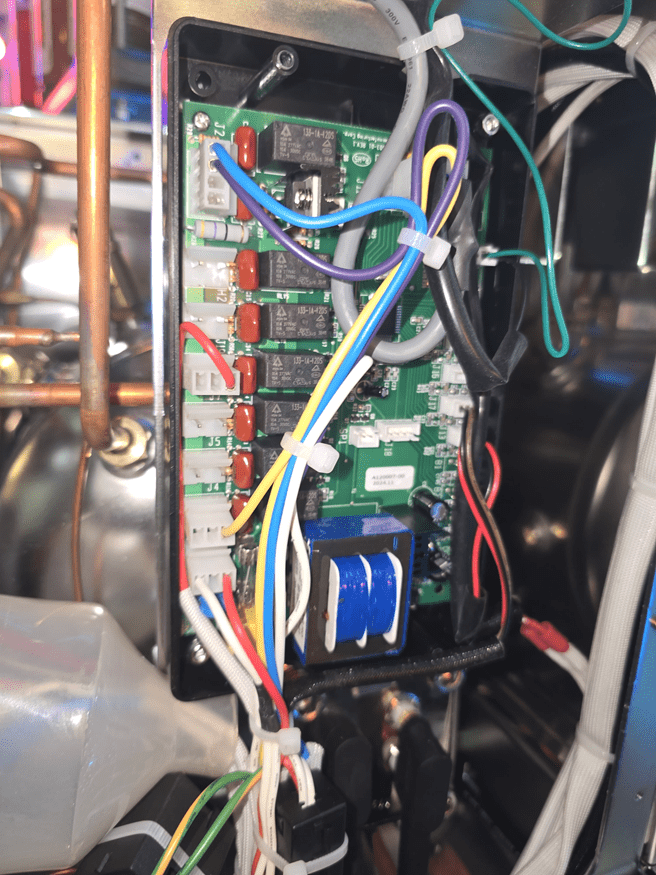
The new control board installed inside the espresso machine — note the color-coded wiring harnesses and relay bank
What Is an Espresso Machine Control Board?
The control board (also called a PCB or printed circuit board) is the brain of your commercial espresso machine. It controls everything:
- Group head temperature management via the PID controller
- Shot timing and volumetric dosing
- Boiler pressure regulation
- Steam wand activation
- Safety cutoffs and error code diagnostics
- Communication between sensors, solenoids, and the pump
When the control board fails, the machine essentially loses its brain. You may see symptoms like random error codes, inconsistent brew temperatures, shots that pull too fast or too slow, or the machine simply refusing to power on.
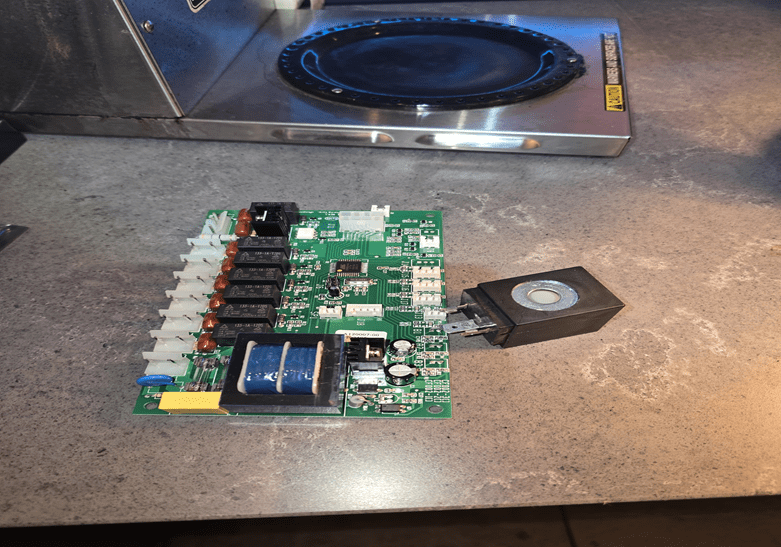
On this particular Estella Caffe machine, the control board (part number A120007-00, manufactured in 2024) had suffered relay damage — likely from a voltage spike. The board featured six high-current relays (rated 133-1A-F205), a large toroidal transformer for power distribution, and multiple labeled connector headers (J2 through J18) for the various machine subsystems.
What Is a Water Solenoid Valve on an Espresso Machine?
The water solenoid valve is an electrically-controlled gate valve that regulates water flow into the group head during espresso extraction. When you press the brew button, the control board sends a signal to open the solenoid valve, allowing pressurized water from the pump to flow through the group head and into the coffee puck.
A failed solenoid can cause:
- Water dripping continuously even when the machine is idle (solenoid stuck open)
- No water flow during extraction (solenoid stuck closed)
- Inconsistent shot volumes
- Unusual buzzing or humming sounds from the solenoid coil
The solenoid we replaced on this job was a standard 24V brass-body solenoid with a black electromagnetic coil housing — a common component found on many commercial espresso machines including Estella Caffe, La Marzocco, Nuova Simonelli, and similar brands. Note the characteristic circular electromagnetic coil housing visible in our photos.
Step-by-Step: How We Performed the Control Board & Solenoid Replacement
Step 1: Full Machine Diagnostic
Before touching any components, our technician performed a complete system diagnostic. This included checking incoming water pressure (should be 45–60 PSI), verifying pump output pressure (9 bars for espresso), reading the machine’s error codes, and testing the solenoid coil resistance with a multimeter. This step is critical — replacing parts without proper diagnosis just wastes time and money.
Step 2: Machine Isolation & Lockout
We followed proper lockout/tagout procedures, disconnecting the machine from both electrical power and the water supply line before beginning disassembly. Commercial espresso machines operate at 120V or 240V and reach water temperatures above 200°F — safety is non-negotiable.
Step 3: Removal of the Failed Control Board
Accessing the control board required removing the machine’s side panel. The existing board was mounted in a black plastic housing secured to the machine’s internal frame. We carefully documented the wiring harness connections — noting the color-coded wires (blue, yellow, white, red, green, purple, gray) and their corresponding connector headers — before disconnecting anything.
The board showed clear signs of relay failure: one relay had visible burn marks, and two others failed continuity tests. The board’s date stamp (2024) confirmed this was a relatively recent unit that had failed prematurely, likely due to a power surge.
Step 4: Water Solenoid Valve Removal
The solenoid valve was accessed from inside the machine’s base. It was connected to the inlet water line via braided stainless steel hose fittings and to the control board via a 2-pin electrical connector. We depressurized the water system fully before disconnecting the water lines to prevent damage.
Step 5: Installation of New Components
We installed OEM-equivalent replacement components:
- New control board (same A120007-00 specification) with all six relays rated and tested
- New 24V solenoid valve assembly, including new coil housing and valve body
- New braided water line connections at the solenoid inlet
All wiring harnesses were reconnected in the correct order and secured with new zip ties for a clean, professional installation.
Step 6: System Testing & Calibration
With everything reconnected, we powered up the machine and ran through a full test cycle:
- Verified correct boiler heating and temperature stability
- Confirmed proper solenoid operation — water flowing on demand, cutting off cleanly
- Pulled test shots and measured extraction time (target: 25–30 seconds for a double shot)
- Checked pump pressure gauge (confirmed 9 bars during extraction)
- Verified steam wand function
- Cleared all error codes from the control board memory
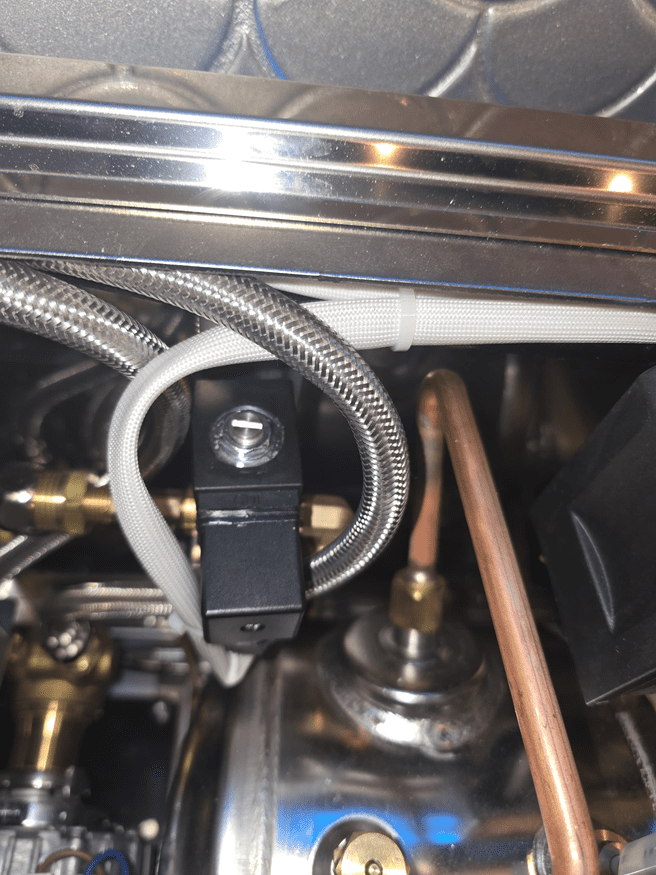
New water solenoid valve installed and plumbed — braided stainless steel lines reconnected
Signs Your Commercial Espresso Machine Needs Immediate Service
If you’re experiencing any of the following symptoms, do not wait — call a certified commercial equipment technician immediately. Continuing to run a damaged espresso machine can cause catastrophic failures, water damage to your facility, or electrical hazards.
- Error codes or fault lights on the display panel
- Inconsistent shot volumes or brew times
- Machine not reaching temperature or overheating
- Water dripping from group head when machine is idle
- Unusual electrical smells or burning odors
- Machine not responding to button inputs
- Steam wand not producing steam or producing too little
- Loud buzzing, clicking, or humming from solenoid or pump
- Pressure gauge reading outside normal range (9 bars for espresso)
Why Operation Comfort Control LLC Is Savannah’s Choice for Commercial Equipment Repair
When a coffee shop in downtown Savannah, GA needs their espresso machine back up and running fast, they call Operation Comfort Control LLC. Here’s why businesses across the Savannah area trust us with their mission-critical commercial equipment:
- Certified technicians with deep experience in commercial espresso machines, refrigeration, ice machines, and cooking equipment
- Fast response times — we understand that equipment downtime costs you money every minute
- Transparent, upfront pricing — no surprise fees
- OEM-quality replacement parts — we don’t cut corners
- Comprehensive preventive maintenance programs that fit your schedule and budget
• Proven track record of successful repairs across restaurants, cafes, hotels, and food service businesses throughout Savannah, GAWe’re not just another repair company. We’re your long-term equipment partner. From walk-in cooler installation and walk-in cooler preventive maintenance to espresso machine repair and commercial cooking equipment service, we keep Savannah’s food service businesses running smoothly.
FAQs: Commercial Espresso Machine Control Board & Solenoid Repair
Q: How long does a control board replacement take?
Most control board replacements on commercial espresso machines can be completed in 2–4 hours, depending on the machine model and parts availability. We keep common components in stock to minimize your downtime.
Q: How much does it cost to replace a commercial espresso machine control board?
Control board replacement costs vary widely by machine brand and model, but typically range from $300 to $900 including parts and labor. A solenoid valve replacement is generally less expensive — often $150 to $350. We provide detailed estimates before any work begins. Contact us for a specific quote.
Q: Can I prevent solenoid valve failures?
Yes! Regular descaling and water filtration maintenance significantly extends solenoid valve life. Hard water deposits and mineral buildup are the number-one cause of solenoid valve failure. A proper water softener or filtration system, combined with regular preventive maintenance, can prevent most solenoid failures.
Q: Do you service other commercial espresso machine brands?
Absolutely. We service all major commercial espresso machine brands including La Marzocco, Nuova Simonelli, Rancilio, Astoria, Breville Commercial, Gaggia, WMF, and many others — in addition to Estella Caffe machines like the one shown in this post.
Q: What areas do you serve?
We primarily serve Savannah, GA and the surrounding greater Savannah area. Contact us to confirm service availability in your specific location.
Check Out More of Our Work
Want to see more examples of our commercial equipment repair and maintenance work? Visit our project gallery to browse before-and-after photos from jobs across the Savannah area.
You can also connect with us and follow our latest work on social media:
- Facebook: Operation Comfort Control LLC
- Google Reviews — See What Our Customers Say
- LinkedIn: Antonio Flint — Operation Comfort Control
