
It is the call every restaurant owner, caterer, and convenience store manager dreads: the walk-in feels warm, the reach-in is sweating, and the thermometer is climbing past safe limits. When you find your commercial refrigerator not cooling, every minute matters. Food safety, inventory, and revenue are all on the line.
The good news is that most cooling failures come from a short list of problems, and many can be spotted in minutes. In this guide, the technicians at Operation Comfort Control, LLC walk you through the most common reasons a commercial refrigerator stops cooling, the quick fixes you can try safely, and the signs that tell you it is time to call a professional.
Why Is a Commercial Refrigerator Not Cooling?
A commercial refrigerator that is not cooling is usually caused by dirty condenser coils, a failed condenser or evaporator fan motor, a faulty thermostat, worn door gaskets, a frozen evaporator coil, a bad compressor or start components, or low refrigerant from a leak. Poor airflow, overloading, and high kitchen temperatures make every one of these problems worse.
What Temperature Should a Commercial Refrigerator Hold?
Before you troubleshoot, confirm there is actually a problem. Under the FDA Food Code, cold food must be held at 41°F (5°C) or below, and commercial freezers should hold 0°F (-18°C). If your unit reads above 41°F for more than a couple of hours, your food is entering the temperature danger zone, and a health inspector will treat it as a violation.
Use a separate, calibrated thermometer placed in a glass of water inside the unit. The built-in display can be wrong, and a faulty display is sometimes the only issue.
10 Common Causes of a Commercial Refrigerator Not Cooling
1. Dirty Condenser Coils
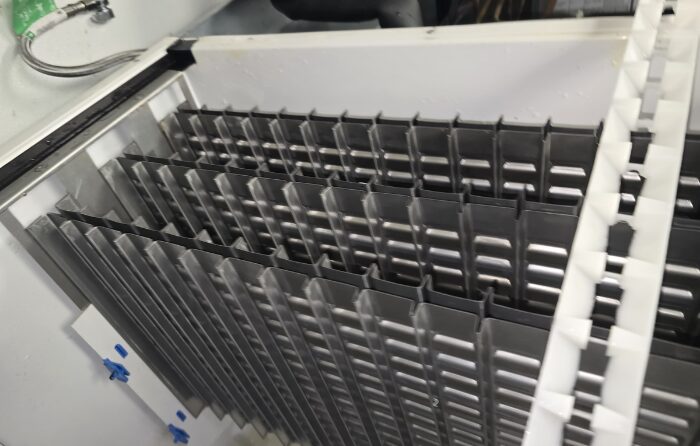
This is the number one cause of a commercial refrigerator not cooling. The condenser coil releases heat pulled from inside the cabinet. In a busy kitchen, grease, flour, and dust coat the coil like a blanket. Heat cannot escape, the compressor runs constantly, and the box slowly warms up. Fix: Power the unit off, brush and vacuum the coil, and clean it at least every 30 to 90 days.
2. Failed Condenser Fan Motor
The condenser fan pulls air across the coil. If it stops or slows down, head pressure rises and cooling drops. A humming motor that will not spin, or a fan blade that turns freely by hand while the unit is off and never runs when it is on, points to a bad motor or capacitor. Fan motors are an inexpensive part when replaced early, but a compressor can burn out if the problem is ignored.
3. Evaporator Fan Problems
Inside the cabinet, the evaporator fan circulates cold air. When it fails, you may hear nothing at all, and the coil may feel cold while the food stays warm. Uneven temperatures, with some shelves cold and others warm, are a classic sign.
4. Frozen or Iced-Up Evaporator Coil
Ice on the evaporator blocks airflow and starves the box of cold air. Causes include a failed defrost heater, a bad defrost timer or control, door gaskets that leak humid air, or a door left ajar. Fix: Turn the unit off and let it defrost fully. If ice returns within days, the defrost system needs repair.
5. Worn or Damaged Door Gaskets
A torn or hardened gasket lets warm, moist air flood in. The compressor works harder, ice builds up, and energy bills climb. Try the dollar bill test: close the door on a bill, and if it slides out easily, the seal is weak. Gaskets are one of the cheapest and fastest repairs.
6. Faulty Thermostat or Temperature Control
If the thermostat is set incorrectly, miscalibrated, or failed, the compressor may never get the signal to run, or it may shut off too early. Check that the setpoint has not been bumped by staff, and that the sensor bulb is properly positioned and not touching the evaporator coil.
7. Compressor or Start Component Failure
The compressor is the heart of the system. If it clicks, hums, trips the breaker, or does not run at all, the problem may be a failed start relay, run capacitor, or the compressor itself. These repairs require a licensed technician with the right tools and refrigerant certification.
8. Low Refrigerant from a Leak
Refrigerant does not get “used up.” If levels are low, there is a leak. Symptoms include long run times, frost on the suction line, hissing sounds, and weak cooling. Topping off without repairing the leak only delays the failure and is not compliant with EPA rules. A certified technician must locate and fix the leak first.
9. Blocked Airflow and Overloading
Packing boxes against the back wall or stacking product in front of the evaporator vents prevents cold air from circulating. Keep an inch or two of space around vents and never cover shelves with foil or liners that block airflow.
10. High Ambient Temperature and Poor Ventilation
Refrigeration equipment is designed for a certain room temperature. Units installed next to fryers, ovens, or griddles, or tucked into tight spaces, struggle to reject heat. Make sure there is proper clearance for ventilation and consider relocating equipment if heat is a recurring issue.
| Cooler Down Right Now? Do Not Wait. Every hour above 41°F puts your inventory at risk. Reach our team through the Operation Comfort Control contact page to schedule fast commercial refrigeration service. |
Quick Reference: Symptoms and Likely Causes
| Symptom | Most Likely Cause | DIY or Pro? |
| Unit runs constantly, warm inside | Dirty condenser coil / low refrigerant | DIY clean, then Pro |
| Fan not spinning | Failed fan motor or capacitor | Pro |
| Ice buildup on back wall | Defrost failure or bad gaskets | Gasket DIY, defrost Pro |
| Compressor clicks, then stops | Start relay or capacitor failure | Pro |
| Warm shelves, cold coil | Evaporator fan or airflow problem | Pro |
| Door will not seal | Worn gasket or hinge | DIY or Pro |
| Display wrong, food warm | Thermostat or sensor fault | Pro |
Quick Checks Before You Call for Service
If your commercial refrigerator is not cooling, run through this short list. It takes about ten minutes and can save you a service call:
- Check power: Confirm the unit is plugged in, the breaker has not tripped, and the outlet works.
- Verify the setpoint: Make sure the thermostat has not been changed or turned to a warmer setting.
- Inspect the doors: Look for items blocking the door, torn gaskets, or doors that do not close fully.
- Look at the condenser coil: If it is covered in dust or grease, clean it with a stiff brush and vacuum after unplugging the unit.
- Listen to the fans: You should hear both condenser and evaporator fans running when the compressor is on.
- Check for ice: Heavy frost on the evaporator means defrost or air leakage trouble.
- Move perishables: If the temperature is above 41°F, move food to a working cooler right away.
Never open electrical panels, handle refrigerant, or bypass safety controls yourself. Those jobs belong to a trained technician.
When to Call a Professional Technician
Call a pro immediately if you notice any of the following: the compressor will not start, the breaker keeps tripping, you smell burning or hear grinding, you see oil stains near refrigerant lines, or the unit keeps warming up after you have cleaned the coils and checked the gaskets. Professional commercial refrigeration repair gets to the root cause the first time and protects your equipment from further damage.
The same principles apply to your freezers. If your ice cream, proteins, or frozen prep are softening, our commercial freezer repair service diagnoses defrost failures, failed evaporator motors, and compressor problems quickly.
How to Prevent Your Commercial Refrigerator From Not Cooling
Almost every breakdown is preventable. A consistent maintenance routine is the most cost-effective way to avoid a surprise failure on a Friday night. Here is what we recommend:
- Clean condenser coils every 1 to 3 months, more often in greasy kitchens.
- Inspect door gaskets monthly and replace them when they crack or stiffen.
- Keep product away from evaporator vents and back walls.
- Log temperatures twice daily so you catch drift before it becomes a failure.
- Never prop doors open during deliveries or prep.
- Schedule professional tune-ups at least twice a year.
For larger operations, a scheduled walk-in cooler preventive maintenance plan includes coil cleaning, fan and motor checks, electrical testing, refrigerant level review, and drain line service. It costs far less than emergency repairs and spoiled inventory.
Repair or Replace? How to Decide
A good rule of thumb: if the repair cost is less than 50 percent of a new unit and the equipment is under 10 to 12 years old, repair it. Replace it if the compressor has failed on an older unit, if repairs are happening several times a year, or if energy bills keep rising. Modern ENERGY STAR commercial refrigerators can cut electricity use noticeably compared with older models.
If replacement is the smarter path, browse our selection of reach-in coolers for sale or prep table coolers to find equipment sized correctly for your kitchen and menu.
Why Local Businesses Trust Operation Comfort Control, LLC
Operation Comfort Control, LLC provides commercial refrigeration, cooking equipment, and food service equipment support for restaurants, schools, gas stations, healthcare kitchens, and retail operations. Our technicians understand that downtime costs money, so we focus on accurate diagnosis, clear communication, and repairs that last.
We proudly serve businesses across southeast Georgia and the South Carolina Lowcountry, including Statesboro, Pooler, Brunswick, Hinesville, Vidalia, Bluffton, and Hilton Head. You can see the full list on our areas we serve page, or explore everything we offer on our commercial equipment services page.
Here is what sets our service apart:
- Experienced, certified commercial refrigeration technicians
- Fast response times for urgent cooling failures
- Honest diagnostics with upfront recommendations
- Repair, maintenance, installation, and equipment sales under one roof
- Preventive maintenance plans that reduce emergency calls
Frequently Asked Questions
Q: Why is my commercial refrigerator running but not cooling?
The most common reasons are dirty condenser coils, a failed condenser fan, a frozen evaporator, or low refrigerant. If the compressor runs without cooling, airflow or refrigerant is usually the issue, and a technician should inspect it quickly.
Q: How long can food stay in a commercial refrigerator that is not cooling?
Food held above 41°F for more than four hours is generally considered unsafe under food safety guidelines. If you cannot confirm how long the temperature was elevated, discard high-risk items such as meat, dairy, and cut produce, and follow your local health department rules.
Q: How much does it cost to fix a commercial refrigerator not cooling?
Costs vary widely. Gasket replacements and coil cleanings are typically affordable, fan motor and thermostat repairs fall in the mid-range, and compressor or sealed-system repairs cost the most. A diagnostic visit gives you an accurate quote before work begins.
Q: How often should commercial refrigeration be serviced?
At minimum, twice a year. High-volume kitchens, bakeries, and grease-heavy environments benefit from quarterly service to keep coils clean and components working properly.
Q: Can I clean condenser coils myself?
Yes, in most cases. Disconnect power, use a stiff brush and a vacuum, and avoid bending the fins. Never use a pressure washer. If the coil is heavily clogged or hard to reach, call a technician.
Final Thoughts
A commercial refrigerator not cooling is stressful, but it does not have to become a disaster. Check the power, setpoint, doors, and coils, move your food to safety, and call a qualified technician when the problem goes deeper. Regular maintenance and prompt repairs keep your equipment efficient, your food safe, and your business running.
| Need Help With a Commercial Refrigerator Not Cooling? (912) 253-4290 at Operation Comfort Control, LLC for dependable diagnosis, repair, and maintenance. View our Google Business Profile, read reviews, and get in touch today. Do not let a warm cooler cost you more than it has to. |
