
If you are a restaurant owner, convenience store operator, or commercial kitchen manager, few things are as critical to your daily operations as reliable cold storage. When your refrigeration goes down, your inventory is at risk, your health code compliance is threatened, and your customers notice. Finding quality refrigeration equipment for sale near me is not just a purchasing decision — it is a business-critical investment.
At Operation Comfort Control, LLC, we do not just sell equipment. We are a full-service commercial refrigeration company providing sales, installation, evaporator changeouts, leak detection, and comprehensive preventive maintenance programs. This blog is your complete guide to understanding commercial refrigeration equipment, making smart purchasing decisions, and keeping your equipment running at peak performance for years to come.
Whether you operate a fast food kitchen, a hotel breakroom, or a multi-unit restaurant group, the team at Operation Comfort Control, LLC has the expertise and local presence to serve you.
Why the Right Refrigeration Equipment Is a Business Decision, Not Just a Purchase
Many business owners make the mistake of treating refrigeration equipment as a commodity — just picking the cheapest unit available online and hoping for the best. But commercial refrigeration is a complex mechanical system that directly affects food safety, energy costs, and kitchen workflow. A poor purchasing decision can cost thousands in emergency repairs, spoiled inventory, and lost business.
Here is what is really at stake when you choose refrigeration equipment for your restaurant or food service business:
- Food safety compliance — improper temperatures lead to failed health inspections and potential liability
- Energy costs — an inefficient unit can add hundreds of dollars per month to your utility bill
- Equipment lifespan — the right unit, properly maintained, can last 15+ years; the wrong one may fail in 3
- Operational continuity — a breakdown during peak service hours can cost you a full day of revenue
- Brand reputation — customers notice when you run out of cold items or close early for equipment failures
This is why when restaurants and food service operators search for refrigeration equipment for sale near me, the smartest ones look beyond price and focus on total value: quality, local support, installation expertise, and ongoing maintenance.
Types of Commercial Refrigeration Equipment We Handle
Operation Comfort Control, LLC works with the full spectrum of commercial refrigeration products and systems. Below is a detailed breakdown of each category, what to look for, and how we can help.
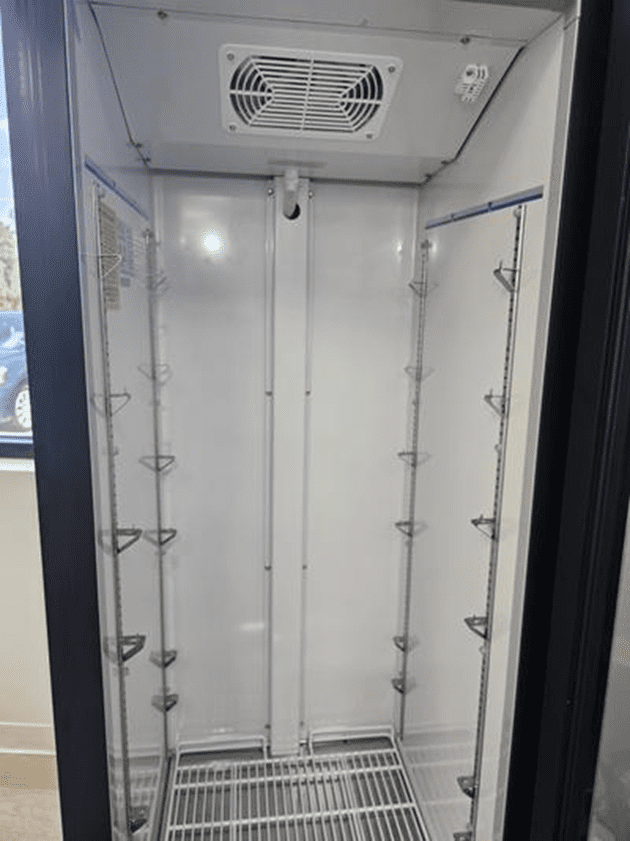
1. Reach-In Freezers and Coolers
Reach-in units are the workhorses of most commercial kitchens and convenience stores. Available in single-door, two-door, and three-door configurations, they provide easy access to frequently used items. Modern reach-ins feature digital temperature controllers (such as the Dixell series), top-mount or bottom-mount fan-cooled evaporators, and durable powder-coated steel interiors that resist corrosion and are easy to clean.
- Key specifications to compare when shopping for reach-in units:
- Interior capacity in cubic feet (typically 20–72 cu ft for single-door commercial units)
- Temperature range: medium-temp coolers (35–38°F) vs. low-temp freezers (-10 to 0°F)
- Condenser location: top-mount (cleaner air, harder to service) vs. bottom-mount (easier access, needs more frequent cleaning)
- Defrost system: electric resistance, hot gas, or off-cycle defrost
- Door type: solid door (better insulation) vs. glass door (product visibility, slightly higher energy use)
Brands like Motak, True, Turbo Air, and Beverage-Air are widely available and have strong national parts networks. When you search for refrigeration equipment for sale near me, reach-ins are typically the most immediately available category from local distributors and dealers.
Interested in installation services? View our walk-in cooler installation page for full-service setup options.
2. Walk-In Coolers and Freezers
Walk-in refrigeration units are essential for any high-volume food service operation. Unlike reach-ins, walk-ins offer large, customizable storage capacity and can be designed to fit virtually any available floor space. A properly designed and installed walk-in cooler dramatically reduces product spoilage, improves kitchen workflow, and allows for bulk purchasing — which lowers your overall food costs.
Walk-in systems consist of several major components: insulated panels (floor, ceiling, walls), a refrigeration system (condensing unit + evaporator coil), door assemblies with heated frames to prevent ice buildup, and a digital temperature controller. The refrigeration system can be self-contained (condensing unit mounted on top of the cooler) or remote (condensing unit located outside or on the roof to reduce heat load inside the building).
Sizing a walk-in correctly is critical. Too small and you run out of space during busy seasons; too large and you pay to cool empty air. Our team helps you calculate the correct box size, refrigeration capacity, and equipment selection based on your menu, inventory volume, and ambient conditions.
Our walk-in cooler preventive maintenance program keeps your investment protected with scheduled inspections, coil cleaning, gasket checks, and refrigerant monitoring.
3. Ice Machines
Ice machines are among the most failure-prone pieces of equipment in a commercial kitchen, largely because they are often neglected. Scale buildup, slime growth, and refrigerant issues can cause a machine to produce less ice, make cloudy or off-tasting ice, or stop producing entirely — usually at the worst possible moment.
When purchasing an ice machine, key considerations include daily production capacity (lbs/day), ice type (cube, nugget, flake, or gourmet), storage bin capacity, and whether the unit is air-cooled or water-cooled. Air-cooled units are more common and less expensive to operate; water-cooled units produce more consistent output in hot environments but use significantly more water.
Operation Comfort Control, LLC offers a dedicated ice machine preventive maintenance program that includes descaling, sanitizing, filter replacement, refrigerant checks, and production verification — keeping your machine producing clean, safe ice consistently.
4. Shake and Frozen Beverage Equipment
Soft-serve machines, milkshake dispensers, slushie machines, and frozen beverage dispensers are complex refrigeration systems that require specialized knowledge to maintain. These are high-margin revenue generators for many restaurant concepts — a machine that is down during peak hours translates directly to lost revenue and frustrated customers.
Our shake and frozen beverage preventive maintenance service includes full disassembly and sanitizing, auger and seal inspection, refrigerant system checks, draw-down testing, and viscosity calibration.
5. Commercial Cooking Equipment
While not refrigeration per se, commercial cooking equipment works hand-in-hand with your cold storage. Fryers, ovens, griddles, and steamers that are not properly maintained generate excess heat that raises ambient kitchen temperatures — making your refrigeration equipment work harder and use more energy.
We offer commercial cooking equipment preventive maintenance as part of a comprehensive kitchen equipment care package, helping you manage the whole picture under one service agreement.
Inside a Professional Evaporator Changeout: Step-by-Step
One of the most common and impactful service jobs we perform is an evaporator coil changeout. When a reach-in or walk-in freezer stops cooling efficiently — or worse, runs constantly but never reaches setpoint — a failed evaporator is often the culprit. Here is an inside look at how Operation Comfort Control, LLC handles this job professionally.
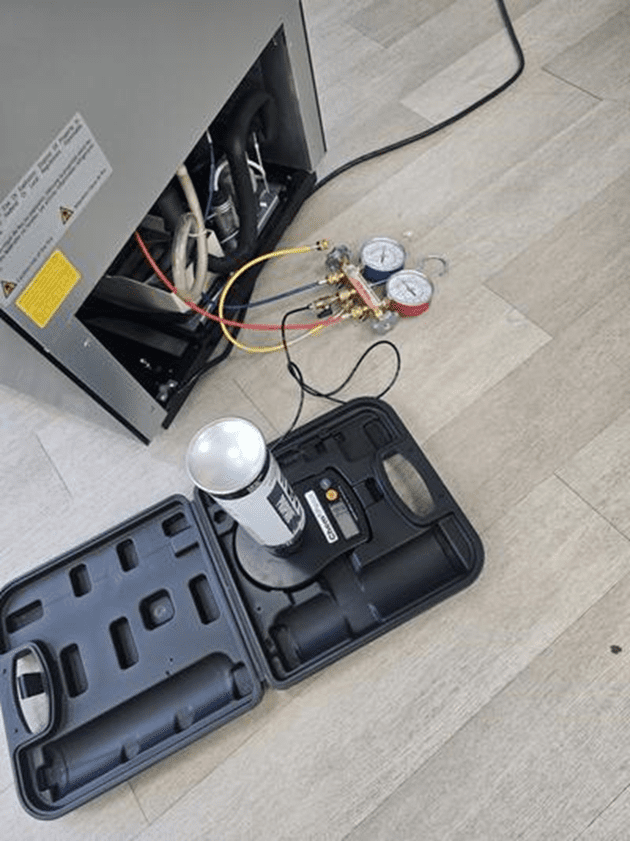
Why Evaporators Fail
Evaporator coils fail for several reasons: refrigerant leaks (often from vibration-induced fatigue cracks at the return bends), defrost heater failure causing excessive ice buildup that eventually crushes the coil fins, corrosion from food acids or cleaning chemicals, or simply age-related metal fatigue. When a coil leaks refrigerant, the system loses its ability to absorb heat from the cabinet, and temperatures rise regardless of how hard the compressor works.
The Changeout Process
Here is what a professional evaporator replacement looks like at Operation Comfort Control, LLC:
- Recover the existing refrigerant charge into a certified recovery cylinder, following EPA Section 608 regulations
- Remove all internal components: evaporator coil, defrost heater, defrost thermostat, drain pan, and fan motor assembly
- Inspect the cabinet for water damage, mold, or insulation degradation that may need to be addressed before installing the new coil
- Install the new evaporator coil assembly — copper tube construction with blue hydrophilic aluminum fins for maximum heat transfer and corrosion resistance
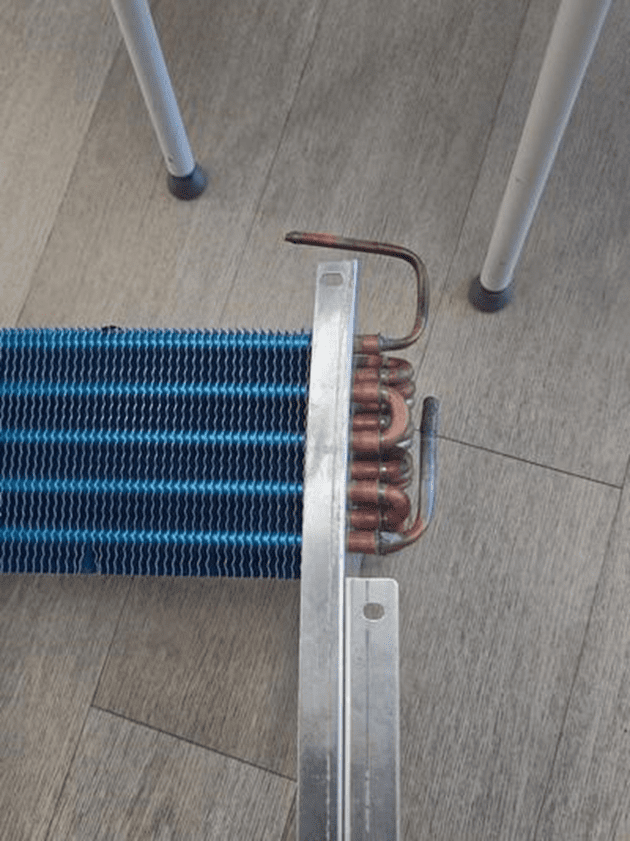
- Braze all refrigerant line connections using nitrogen-purged brazing technique to prevent internal oxidation scale
- Install new defrost heater, defrost thermostat, and drain line with proper slope and heat tape where required
- Leak test the system using nitrogen pressure before pulling vacuum
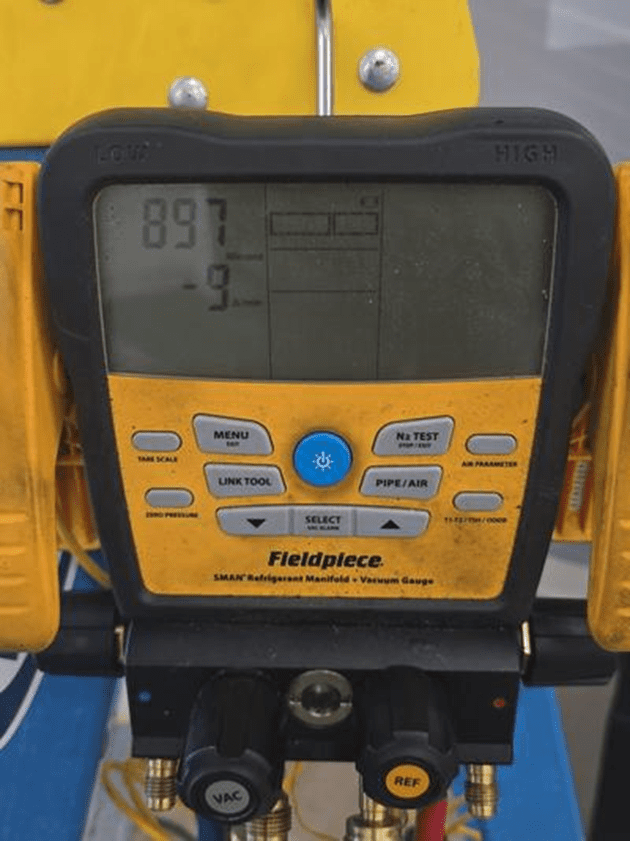
- Pull a deep vacuum to 500 microns or below, verified using a Fieldpiece SMAN refrigerant manifold and vacuum gauge
- Hold vacuum for a minimum decay test period to confirm system integrity
- Recharge with the correct refrigerant type and factory-specified weight
- Verify operating temperature pulldown via digital controller display
- Document all readings, refrigerant quantities, and service notes for the client’s equipment records
The vacuum reading matters enormously. A system evacuated to 500 microns or below is essentially free of moisture and non-condensable gases, which cause acid formation inside the refrigerant circuit and dramatically shorten compressor life. Technicians who skip a proper evacuation are cutting corners that will cost the equipment owner thousands of dollars down the road.
Real Job Spotlight: Motak Reach-In Freezer in a Breakroom
Here is a real job completed by Operation Comfort Control, LLC that illustrates the full scope of what we do — from diagnosis through commissioning.
The Problem
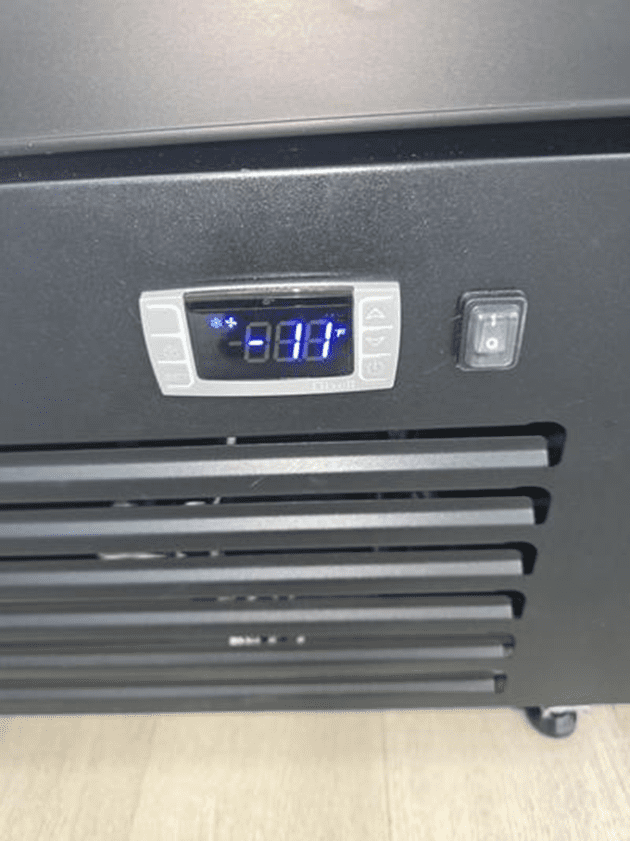
A client’s facility had a Motak single-door reach-in freezer in the breakroom that was failing to hold temperature. The Dixell digital controller was displaying a temperature significantly warmer than the -11°F setpoint. The unit was running continuously but not cooling. Staff had already lost a quantity of frozen food.
The Diagnosis
Our technician performed a full system inspection including refrigerant pressure check, temperature differential measurement across the evaporator coil, and visual inspection of the coil assembly. The evaporator was found to be severely iced over due to a failed defrost heater, and there was evidence of a small refrigerant leak at one of the return bend connections. The ice buildup had become so severe that airflow through the coil was completely blocked — essentially turning the evaporator into an insulated block of ice.
The Solution
Our team performed a complete evaporator changeout:
- Recovered the existing R-290 (propane-based refrigerant) charge following EPA 608 protocol
- Removed and replaced the failed evaporator coil with a new copper-tube / blue aluminum-fin assembly
- Replaced the defrost heater element, defrost thermostat, and drain pan
- Brazed all connections under dry nitrogen flow to prevent internal oxidation
- Evacuated the system to 897 microns as confirmed on the Fieldpiece SMAN digital manifold gauge
- Recharged with factory-specified R-290 weight, verified on a calibrated refrigerant scale
- Confirmed pulldown to -11°F on the Dixell controller within the expected timeframe
Total job time: approximately 4.5 hours. The unit was back in service the same day with a full service report provided to the client. The client is now enrolled in our preventive maintenance program to prevent recurrence.
How to Evaluate Refrigeration Equipment for Sale Near Me: A Buyer’s Checklist
Not all refrigeration equipment for sale near me is equal in quality, reliability, or long-term value. Use this checklist when evaluating any unit before committing to a purchase.
✓ Brand Reputation and Parts Availability
Stick with established brands: True Manufacturing, Turbo Air, Hoshizaki, Beverage-Air, Motak, Continental, and Traulsen are all well-supported with nationwide parts networks. Lesser-known import brands may offer tempting upfront prices but can leave you waiting weeks for parts during a breakdown.
✓ Refrigerant Type
Always confirm the refrigerant type before purchasing. R-22 equipment is being phased out and refrigerant costs have skyrocketed. R-290 (propane-based, natural refrigerant) is increasingly the preferred choice for small reach-in commercial refrigeration — it is highly efficient, environmentally friendly, and relatively inexpensive. R-404A and R-448A are common in medium and low-temp commercial applications.
✓ Compressor Brand
The compressor is the heart of the refrigeration system. Look for units equipped with Embraco, Copeland, Secop, or Danfoss compressors — all of which are industry-standard brands with widely available replacement parts. Ask whether the compressor is a hermetic or semi-hermetic design (hermetic is sealed and must be replaced as a unit; semi-hermetic can be rebuilt).
✓ Electrical Requirements
Confirm whether the unit requires 115V/60Hz single-phase or 208-230V/60Hz power. Most small reach-ins run on standard 115V household current, but larger units and walk-ins typically require a dedicated 208-230V circuit. Plugging a 208-230V unit into a 115V outlet — or vice versa — can cause immediate and permanent damage.
✓ Warranty Coverage
Look for a minimum 1-year parts and labor warranty, with 5-year compressor warranty as the industry standard. Confirm whether the warranty requires installation by a certified technician and whether local service is available within your area to honor warranty claims without shipping the unit.
✓ Total Cost of Ownership
Divide the total expected cost (purchase price + estimated annual energy cost + expected maintenance costs) by the expected lifespan in years. A $1,500 unit that costs $600/year to operate and $400/year to maintain over 6 years costs you more than a $2,200 unit that operates efficiently for 15 years with proper PM.
Why Buy Local? The Case for Operation Comfort Control, LLC
When you search for refrigeration equipment for sale near me, you have options: national online retailers, big-box wholesale clubs, regional distributors, and local specialists. Here is why choosing a local expert like Operation Comfort Control, LLC makes the most sense for your business.
- Fast response time when something goes wrong — we are in your market, not shipping from a warehouse 1,000 miles away
- A technician who knows your specific equipment, your installation history, and your facility layout
- Proper startup commissioning that validates your warranty and ensures the unit is operating to spec
- Ongoing preventive maintenance to catch developing problems before they become expensive emergencies
- A single point of contact for sales, installation, service, and preventive maintenance
- Transparent pricing with no hidden fees or surprise surcharges
We take pride in showing up on time, doing the work right the first time, and building long-term relationships with every client we serve. Our documentation standards ensure you always have a complete service history for your equipment — which matters for warranty claims, health inspections, and resale value.
Learn more about our team and our mission on the About Us page.
10 Maintenance Habits That Extend the Life of Your Refrigeration Equipment
The best refrigeration equipment for sale near me will still fail prematurely without proper care. These are the ten most impactful maintenance habits for restaurant and food service operators:
Clean condenser coils every 90 days — monthly in high-grease or dusty environments. Dirty coils are the #1 cause of premature compressor failure.
- Inspect and replace door gaskets when cracked, torn, or loose. A bad gasket lets warm humid air into the cabinet, causing excessive frost and forcing the compressor to run overtime.
- Keep the area around condenser coils clear. Bottom-mount units need at least 6 inches of clearance on all sides for adequate airflow.
- Never overload the cabinet. Overcrowding blocks internal airflow and forces the evaporator to work harder than it was designed to.
- Monitor and log temperatures daily. An unexplained 3–5° rise in cabinet temperature is an early warning sign of a developing problem.
- Keep the drain pan and drain line clean. A blocked drain causes water to back up into the cabinet, creating a health hazard and accelerating evaporator corrosion.
- Defrost the unit on schedule if it uses manual or off-cycle defrost. Heavy ice buildup blocks airflow and stresses the evaporator coil.
- Check refrigerant charge annually via a certified technician. Low refrigerant is almost always the result of a leak that will get worse over time.
- Inspect fan blades and motors every 6 months. A fan motor that is beginning to fail will show increased current draw before it stops working entirely.
- Schedule professional preventive maintenance at least twice per year — more frequently for high-use units in demanding environments.
A refrigeration system that receives proper preventive care will typically last 12–18 years. One that is neglected commonly needs replacement in 5–7 years, sometimes sooner if a compressor failure results in acid burnout of the entire refrigerant circuit.
View our complete range of preventive maintenance programs on our Services page.
Ready to Find the Best Refrigeration Equipment for Sale Near Me?
Whether you need a brand-new reach-in freezer, a complete walk-in cooler installation, an emergency evaporator changeout, or a reliable preventive maintenance partner for your entire kitchen, Operation Comfort Control, LLC is your local expert.
We serve restaurants, convenience stores, hotel breakrooms, cafeterias, and commercial kitchens throughout the region. Our technicians are trained, certified, and equipped with professional tools to get the job done right the first time. We document every job, stand behind our work, and will be there when you need us.
Stop gambling on generic online purchases with zero local support. Partner with a team that treats your equipment like their own.
