
Why the Holidays Put Your Walk-In Cooler Under Pressure
The holiday season is the busiest stretch of the year for restaurants, hotels, caterers and convenience stores across coastal Georgia and the South Carolina Lowcountry. Your walk-in cooler is packed with turkeys, hams, seafood, dairy, fresh produce, sauces and desserts. When it stops holding temperature in the middle of that rush, the damage is immediate. Walk-In Cooler Failure During the Holidays can wipe out thousands of dollars of inventory in a single night, force you to pull items off the menu and put customers at risk.
The good news is that most breakdowns send warning signs first. In this guide, Operation Comfort Control, LLC explains why walk-in cooler failure during the holidays happens, how to spot trouble early, what to do in the first 30 minutes and how to protect your kitchen before the rush begins.
Cooler down right now? Call Operation Comfort Control, LLC at (912) 253-4290. We answer the phone, dispatch fast and are open 24/7, day or night.
Why Walk-In Cooler Failure During the Holidays Happens So Often
A walk-in cooler runs around the clock, and the holidays add extra strain. Several things stack up at the same time:
- Heavier loads. A packed cooler blocks airflow around the evaporator coil, so the system works harder and cools less evenly.
- More door openings. Staff go in and out all day during peak service, which lets warm, humid air inside and pushes the compressor to run longer.
- Dirty condenser coils. Dust and grease build up over months. A clogged coil cannot release heat, and the compressor overheats.
- Worn door gaskets. A cracked or loose seal leaks cold air, causes frost and drives up your energy bill.
- Coastal humidity. Moist air in Savannah and the Lowcountry creates extra condensation and ice, especially around door frames and evaporators.
Add the fact that parts and technicians are in high demand right before Thanksgiving and Christmas, and a small problem can turn into a long outage if you wait.
What a Cooler Failure Really Costs Your Business
Most owners only think about the food, but the loss goes further than that. A single breakdown can cost you in four ways:
- Lost inventory. Proteins, dairy and prepared items are expensive, and holiday stock levels are at their highest.
- Lost sales. If you cannot serve key dishes or fill catering orders, customers go elsewhere.
- Emergency pricing and rush deliveries. Replacing stock on short notice costs more, and temporary cold storage is hard to find during peak season.
- Health and reputation risk. Serving food that spent too long above safe temperatures can lead to illness complaints, violations and bad reviews.
7 Warning Signs Your Walk-In Cooler Is About to Fail
Catching these signs early gives you time to fix the problem on your schedule instead of in the middle of a dinner rush:
- The temperature drifts up by a few degrees or swings during the day.
- Ice or heavy frost builds up on the evaporator coil, walls or floor.
- The compressor runs nonstop or cycles on and off every few minutes.
- You hear grinding, rattling, buzzing or squealing from the fan or compressor.
- Water pools on the floor or drips from the ceiling.
- The door does not close tightly, or you see gaps in the gasket.
- Your electric bill climbs without a change in business volume.
If you notice even one of these, schedule commercial refrigeration repair before the holiday rush. Early repairs are almost always cheaper and faster than emergency ones.
What to Do in the First 30 Minutes of a Cooler Failure
When walk-in cooler failure during the holidays actually hits, stay calm and work through this plan. Print it and keep it near the cooler door.
- Check the basics. Confirm the unit has power, the breaker has not tripped and the thermostat is set correctly. Make sure the door is fully shut.
- Read and record the temperature. Write down the time and the reading. This starts your food safety timer.
- Stop opening the door. Every opening lets cold air escape. A closed cooler can hold safe temperatures much longer than an open one.
- Call a commercial technician. Do not wait to see if the problem fixes itself. Give the technician the equipment brand, the symptoms and the current temperature.
- Move high-risk food first. Shift raw meat, poultry, seafood and dairy into another working cooler, reach-in unit or insulated containers with ice.
- Protect the freezer too. If your freezer is also struggling, ask the technician to inspect it at the same visit and book commercial freezer repair if needed.
- Document everything. Keep temperature logs and photos. They help with insurance claims and health department questions.
Do not wait for a breakdown. Book a pre-holiday cooler inspection through our contact page or call (912) 253-4290 today.
Food Safety Guide: When Is Food No Longer Safe?
Perishable foods, often called time and temperature control for safety foods, should stay at 41°F or below. Once the cooler rises above that line, the clock is running. Use this simple guide and always confirm the details with your local health department:
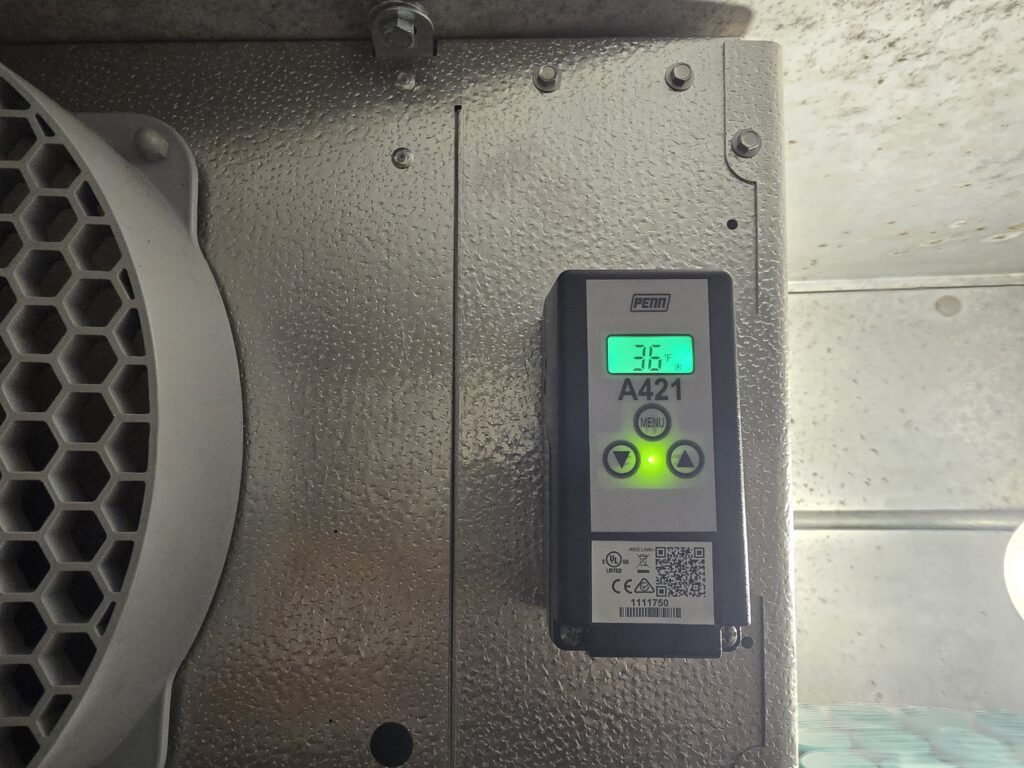
A PENN A421 controller reading 36°F, a healthy temperature that sits inside the safe zone for a walk-in cooler.
| Cooler temperature | What it means | What to do |
| 35°F to 38°F | Normal operating range | Keep logging temperatures twice a day |
| 39°F to 41°F | Early warning zone | Check door seals and airflow, then call for service |
| Above 41°F | Unsafe for perishable food | Start a timer, move critical items, call a technician |
| Above 41°F for 4+ hours | High spoilage risk | Follow local health department guidance on discarding food |
When in doubt, throw it out. The cost of replacing food is small compared with the cost of a foodborne illness claim or a failed inspection.
Pre-Holiday Checklist to Prevent Cooler Failure
The most reliable way to avoid walk-in cooler failure during the holidays is a scheduled inspection before demand peaks. A professional walk-in cooler preventive maintenance visit typically covers these items:
- Condenser and evaporator coils: cleaned so heat moves freely and the compressor does not overwork.
- Door gaskets, hinges and closers: inspected and replaced if worn.
- Refrigerant levels and electrical connections: tested to catch slow leaks and loose wiring.
- Fan motors and defrost system: checked for proper operation to prevent ice buildup.
- Drain lines: cleared so water does not back up or freeze.
- Temperature controls and alarms: calibrated so you know about a problem before your food does.
During a visit, the technician also inspects the condensing unit, controller and refrigerant circuit, which are the parts that keep your cooler running through a busy holiday weekend.
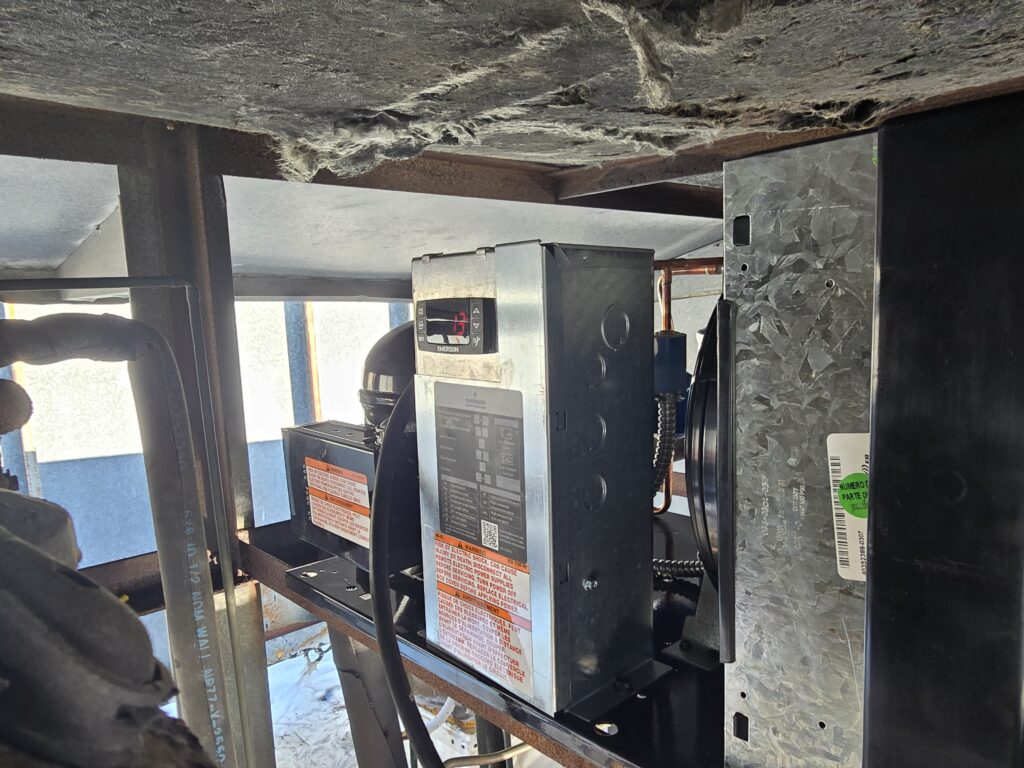
Emerson controller and condensing unit. Electrical connections, controls and alarms are checked during preventive maintenance.
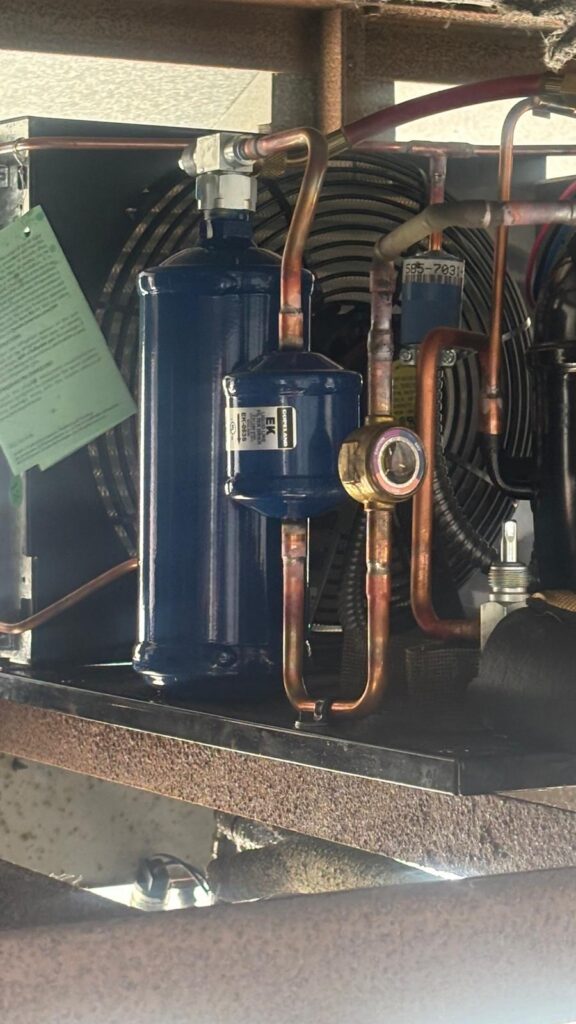
Filter drier and sight glass on a refrigeration line. Checking them helps protect the compressor from moisture and contamination.
Between visits, your team can help too. Log temperatures twice a day, do not block the evaporator fan with boxes, keep product off the floor and wipe up spills quickly.
Remember your other cold equipment. A busy holiday weekend can also overload your ice machine, so a quick ice machine preventive maintenance service at the same visit keeps drinks and seafood displays running smoothly.
Repair or Replace? How to Decide
Not every failing cooler needs to be replaced. A good technician will tell you honestly which path makes sense. Generally, repair makes sense when the problem is a failed part such as a fan motor, a thermostat or a gasket, and the box and system are otherwise in good shape.
Replacement is worth considering when the unit is very old, repairs keep repeating, the panels are damaged or insulation is wet, or your energy bills keep rising. If you are expanding or opening a new location, professional walk-in cooler installation gives you a properly sized system that is set up correctly from day one.
Why Savannah Businesses Trust Operation Comfort Control, LLC
Operation Comfort Control, LLC is a commercial equipment service company based at 100 Bull St., Savannah, GA 31401. We work with restaurants, hotels, convenience stores, cafés and other food service businesses that cannot afford downtime. Here is what sets us apart:
- Open 24/7. Coolers do not fail on a convenient schedule, so we do not keep a convenient schedule either.
- Certified technicians. We repair and maintain major commercial kitchen equipment brands, including Hoshizaki, Manitowoc, Henny Penny, Frymaster, Blodgett and Franke.
- Warranty you can trust. OEM parts carry a 90 to 180 day warranty, and we stand behind our service.
- Clean, careful work. Customers regularly mention that our team is professional, works around store operations and cleans up after every job. You can see examples in our before and after gallery.
Want to see what customers say? Find Operation Comfort Control, LLC on Google and read our reviews.
Service Areas
We provide same-day service for commercial refrigeration and kitchen equipment across Savannah, Pooler, Richmond Hill, Beaufort, Bluffton, Hilton Head, Hinesville, Brunswick, Statesboro, Vidalia, Metter and Jesup. Check the full list on our service area page to confirm coverage for your location.
FAQ: Walk-In Cooler Failure During the Holidays
How long can food stay in a broken walk-in cooler?
It depends on the temperature and how often the door is opened. As a general rule, perishable food above 41°F for more than four hours should be discarded. Keep the door closed, move high-risk items to working cold storage and follow your local health department guidance.
What is the most common cause of walk-in cooler failure?
Dirty condenser coils, failed fan motors, worn door gaskets and low refrigerant are among the most common causes. Most of them can be caught during routine maintenance.
How often should a commercial walk-in cooler be serviced?
Most commercial kitchens benefit from professional maintenance at least twice a year, with an extra inspection right before the holiday season or any other peak period.
Can I fix a walk-in cooler myself?
You can check the power, thermostat and door seal, and you can keep the area around the unit clear. Refrigerant, electrical and compressor problems should always be handled by a licensed commercial technician for safety and warranty reasons.
Who do I call for emergency walk-in cooler repair in Savannah, GA?
Call Operation Comfort Control, LLC at (912) 253-4290. We are open 24/7 and serve Savannah, Pooler, Richmond Hill, Beaufort and nearby areas.
Final Thoughts: Protect Your Holiday Season Before It Starts
Walk-In Cooler Failure During the Holidays is one of the most expensive problems a food business can face, but it is also one of the most avoidable. A little attention now, including temperature logs, a clean coil, a tight door seal and a professional inspection, can save you from a spoiled inventory and a stressful holiday weekend.
Take one step today: inspect your cooler, write down your emergency plan and schedule service before the rush. If you need help, the team at Operation Comfort Control, LLC is ready to keep your kitchen cold, compliant and open for business.
Schedule your pre-holiday cooler inspection now. Call (912) 253-4290 or visit us at 100 Bull St., Savannah, GA 31401. Open 24/7 for emergencies.
